F8 vs F11 Structural Plywood: Grades, Applications & How to Choose the Right Product
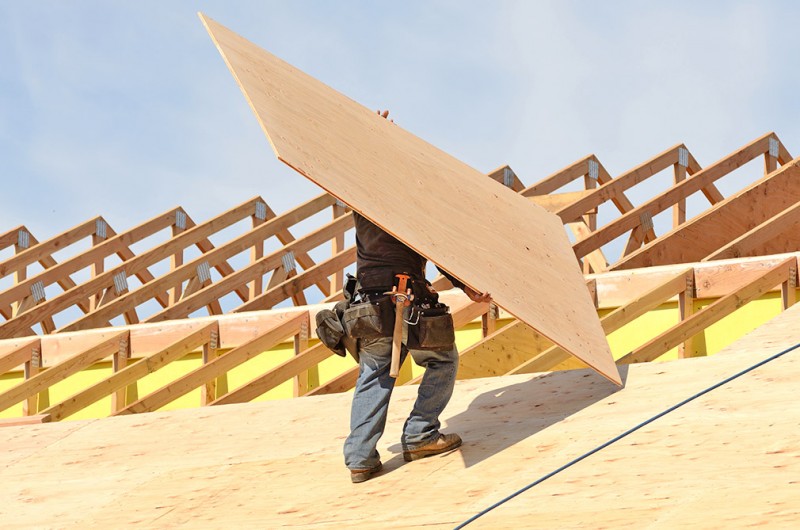
Structural plywood is not selected by thickness alone. For builders, distributors and construction-material buyers, the correct panel must match the required stress grade, structural application, bond durability, panel dimensions, service conditions and destination-market standard.
F8 and F11 are stress grades commonly encountered in Australian/New Zealand structural plywood specifications. They should not be interpreted as simple universal “strength numbers,” and F11 should not automatically be described as the better choice for every project. The required grade depends on the structural design and the properties declared for the exact plywood product.
This guide explains the practical difference between F8 and F11 structural plywood, the factors that affect panel performance, and the information B2B buyers should verify before placing an order.
What Is Structural Plywood?
Structural plywood is a veneer-based wood panel manufactured for load-bearing building applications under an applicable structural plywood standard. Adjacent veneer layers are typically arranged with alternating grain directions, creating a cross-laminated panel structure that distributes loads in two principal directions and improves dimensional stability.
Its performance depends on more than veneer count. Relevant factors include veneer quality and lay-up, panel thickness, bond durability, manufacturing control, declared stress grade and the standard under which the product is evaluated.

What Do F8 and F11 Mean?
F8 and F11 are structural plywood stress grades used in markets that apply the relevant Australian/New Zealand grading framework. A stress grade represents a defined set of characteristic/design properties used for engineering, rather than a single standalone load-capacity value.
In general, F11 represents a higher stress grade than F8 within the same grading system. However, the correct product choice must still be based on the project’s structural design, panel thickness, span/support conditions, load direction, bond/exposure requirements and the verified properties of the exact product.
This is why buyers should avoid treating F11 as an automatic upgrade from F8 without checking the specification.
F8 vs F11 Structural Plywood: Practical Comparison
| Factor | F8 Structural Plywood | F11 Structural Plywood |
| Stress grade | F8 | F11 |
| Relative grade level | Lower than F11 within the same grading framework | Higher than F8 within the same grading framework |
| Typical selection logic | Used where the engineering specification calls for F8 or equivalent verified properties | Used where the engineering specification calls for F11 or higher verified properties |
| Application | Project- and design-dependent | Project- and design-dependent |
| Final selection | Check thickness, span, loads, bond, standard and product data | Check thickness, span, loads, bond, standard and product data |
The key purchasing point is simple: F8 and F11 are not application labels such as “residential” and “commercial.” A residential project can require F11, while another project may be designed around F8. The engineering specification decides the required grade.
What Determines Structural Plywood Performance?
1. Stress Grade and Verified Properties
Confirm the grade and the corresponding technical data for the exact panel. Do not use generic plywood strength claims for structural design.
2. Panel Thickness and Support Conditions
Thickness, support spacing, span direction and loading all influence panel behavior. A higher grade does not remove the need for correct thickness and structural design.
3. Veneer Quality and Lay-Up
Veneer selection, orientation and lay-up affect panel consistency and mechanical performance.
4. Bond Durability and Exposure
Structural grade and bond/exposure classification are different issues. Buyers should separately confirm the bond type and service environment required by the project.
5. Manufacturing and Quality Control
Glue preparation, veneer moisture, lay-up, pressing and finished-product inspection all influence repeatability.
6. Destination-Market Compliance
Standards and documentation vary by country. The required structural plywood standard, certification, treatment and marking should be confirmed before ordering.
Where Is Structural Plywood Commonly Used?
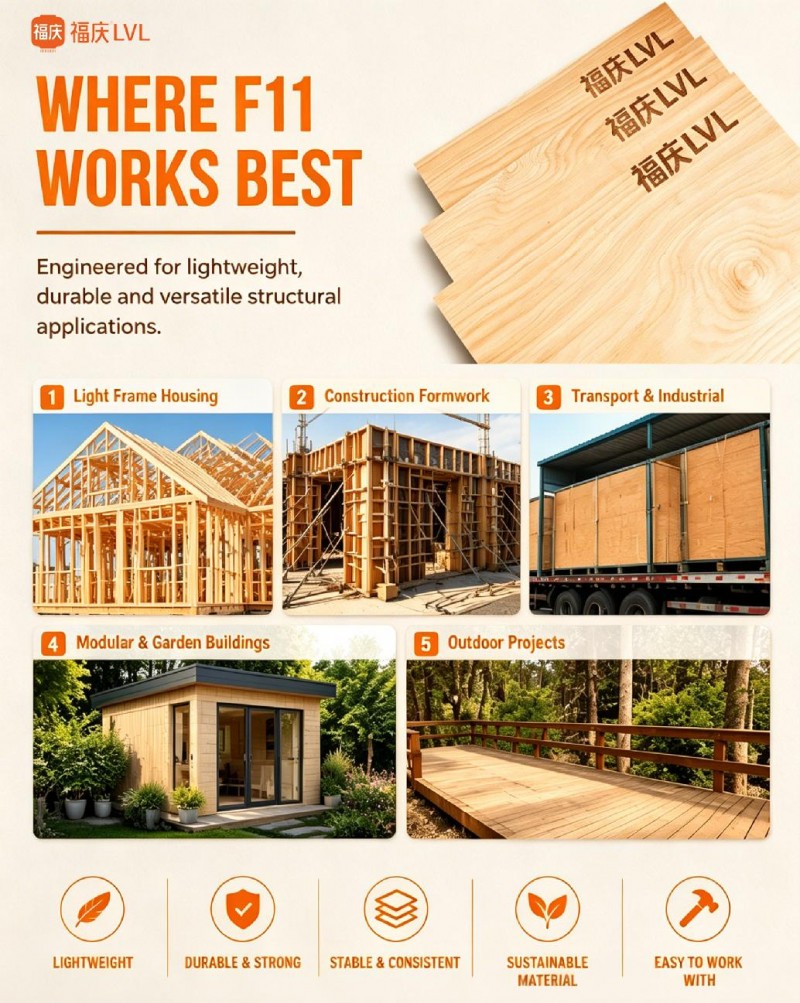
Depending on the exact grade, thickness, bond classification and engineering design, structural plywood may be used in applications such as:
Flooring and subfloor systems
Wall sheathing and bracing systems
Roof sheathing and roof structures
Structural components in timber-frame construction
Selected prefabricated and modular building systems

What Buyers Should Check Before Purchasing F8 or F11 Plywood
Required stress grade: F8, F11 or another specified grade
Applicable structural plywood standard and destination market
Panel thickness × width × length
Structural application, span/support conditions and drawings where available
Bond/exposure requirement and any preservative-treatment requirement
Face/back grade and surface requirements
Required certification, test reports, marking and traceability
Quantity, packaging, container loading and target delivery schedule
For importers and distributors, it is also important to distinguish structural grade from other requirements. For example, a request for F11 plywood does not by itself define bond type, preservative treatment, emissions class, surface grade or market compliance. These items should be confirmed separately.
How Fuqing Supports Structural Plywood Buyers
Founded in 1990, Jiangsu Fuqing Wood Co., Ltd. integrates wood processing, engineered wood manufacturing and international trade. Fuqing supplies plywood and engineered wood products to international customers alongside structural LVL, non-structural LVL, SLVL, I-joists and LVL scaffold planks.
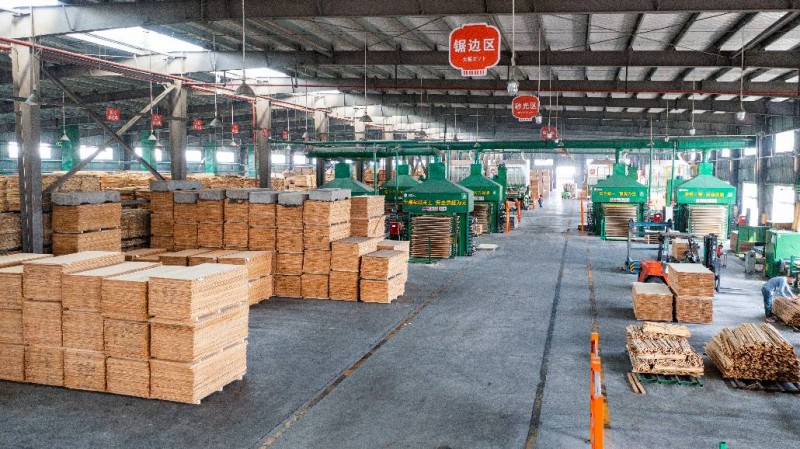
For plywood projects, Fuqing focuses on production controls including veneer preparation, moisture management, adhesive preparation, lay-up, pressing and finished-product inspection. The objective is to provide repeatable panels that match the confirmed specification rather than apply one generic plywood configuration to every market.
Fuqing operates a manufacturing base of approximately 300,000 m² with annual overall output of approximately 350,000 m³. For F8/F11 inquiries, the exact grade, panel construction, bond, treatment, standard and supporting documentation should be confirmed against Fuqing’s current product capability before quotation and publication.
Send Fuqing Your Structural Plywood Requirements
If you are sourcing structural plywood for construction, distribution or prefabrication, send Fuqing your project requirements:
Stress grade
Thickness × width × length
Application and drawings, if available
Destination market
Required standard/certification
Bond/exposure and treatment requirements
Face/back or surface requirements
Quantity, packaging and delivery schedule
Fuqing can review the requested specification, confirm available plywood options and prepare a quotation based on the actual project and market requirements.
REQUEST A QUOTE | VIEW STRUCTURAL PLYWOOD | CONTACT FUQING
Frequently Asked Questions
What is structural plywood?
Structural plywood is a veneer-based panel manufactured and evaluated for structural building applications under an applicable standard.
What is the difference between F8 and F11 structural plywood?
Within the same stress-grading framework, F11 is a higher stress grade than F8. The required grade still depends on the project’s engineering specification and the exact product data.
Is F11 always better than F8?
No. A higher grade is not automatically the most appropriate or economical choice. Use the grade specified for the structural design.
Does F11 automatically mean waterproof or treated plywood?
No. Stress grade, bond/exposure classification and preservative treatment are separate requirements and should be confirmed independently.
What information should buyers provide for a quote?
Provide grade, dimensions, application, destination market, standard, bond/exposure, treatment, surface requirements, quantity and delivery needs.
Can Fuqing customize structural plywood?
Fuqing can evaluate requested panel specifications within its confirmed manufacturing capability. Structural grade and compliance must be verified for the exact product configuration.
Email:fuqinglvl@fuqingmuye.com
Web: http://www.fuqingmuye.com