Synology L0CK3D Ransomware Attack: Shemo NoRansom Recovery Guide
Over the past few days, system administrators and homelab maintainers across global tech communities have woken up to a shared nightmare: long-running Synology NAS units suddenly locked down overnight. Upon logging into DSM and opening File Station, users are finding that production databases, virtual machine images, shared folders, and even scheduled daily, weekly, and monthly local backups have all been appended with the .L0CK3D. or .L0CK3D extension (spelled with a zero and a three). Across the root directory and every affected volume, a ransom note named read-me3.txt—headlined with C3RB3R INSTRUCTIONS—demands cryptocurrency in exchange for a decryption key.
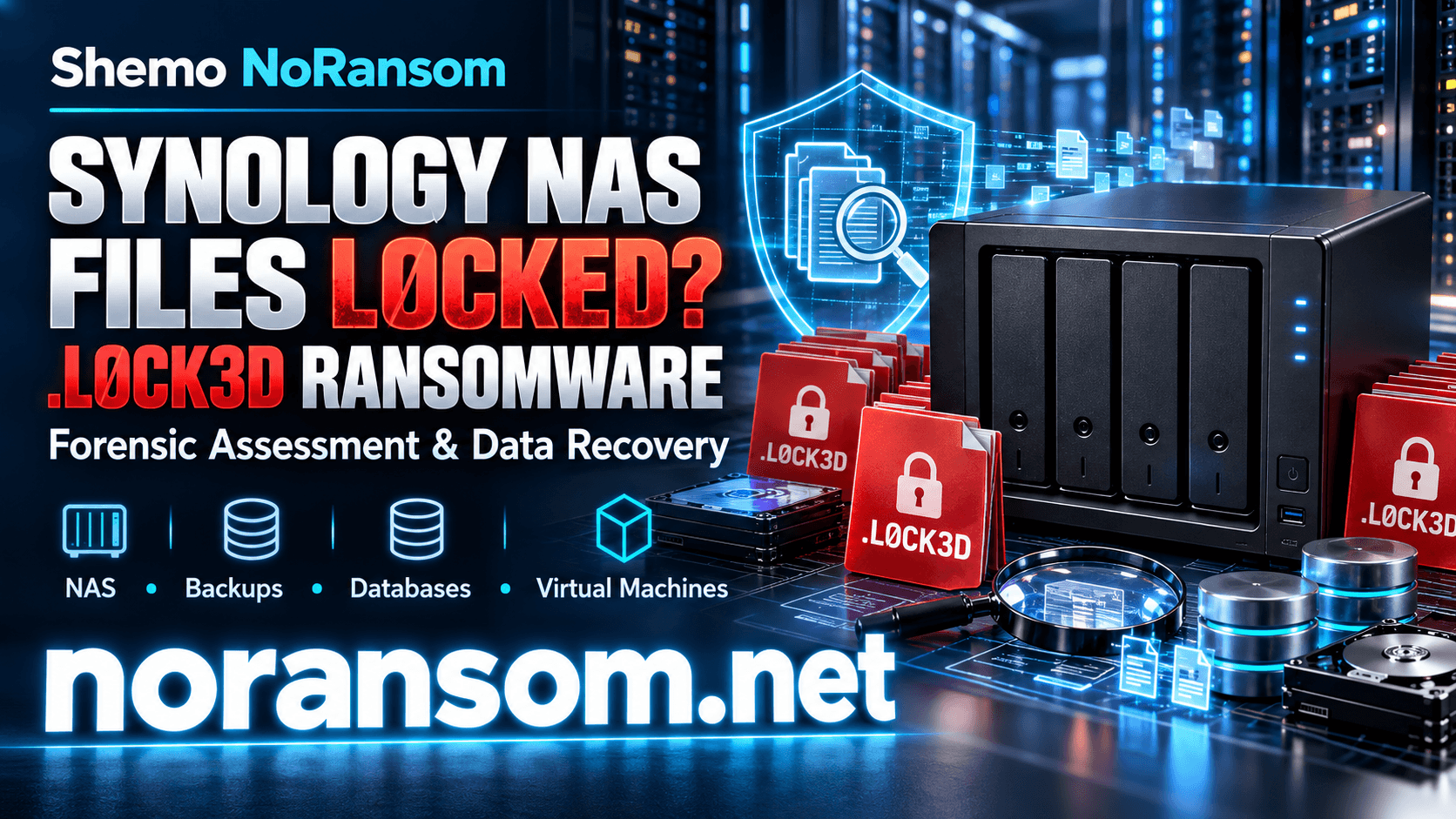
What makes this wave particularly devastating is that many victims had configured high-redundancy RAID 6 arrays and had even patched their Docker containers days before the encryption triggered, yet their entire storage pools were still wiped out. Facing total data paralysis, the enterprise ransomware decryption and emergency incident response specialists at Shemo NoRansom (noransom.net) have analyzed live forensic samples from this outbreak to break down the exact attack vector and outline a proven, zero-ransom path to data reconstruction.
1. Post-Mortem Analysis: How Did .L0CK3D Bypass Patched Containers and RAID 6?
Why are rock-solid Synology NAS units suddenly falling victim to .L0CK3D (tracked as the C3RB3R / Lock3d strain)? Forensic investigations conducted by the Shemo NoRansom Incident Response Team reveal that these incidents are rarely caused by traditional Windows SMB lateral movement. Instead, threat actors are weaponizing newly disclosed CVSS 10.0 Unauthenticated Remote Code Execution (RCE) vulnerabilities to conduct automated mass harvesting against internet-facing NAS services:
Vector 1: Container Manager (Docker) RCE + Silent crond Persistence
Many development teams and SMBs run self-hosted GitLab CE, Atlassian Confluence, or other web services inside Synology Container Manager (Docker) with ports forwarded to the public internet. In mid-to-late October 2026, critical CVSS 10.0 RCE vulnerabilities (such as CVE-2026-110264 and CVE-2026-97229 in GitLab) were actively exploited in the wild. Crucially, after compromising unpatched containers, attackers did not trigger encryption immediately. Instead, leveraging privileged volume mounts or host escape misconfigurations, they injected malicious fetch-and-execute scripts directly into the underlying Linux crond (scheduled tasks). This explains why administrators who updated their containers to the latest patched versions days ago still got hit today—the dormant time bomb hiding in /etc/crontab detonated on schedule.
Vector 2: Synology “PHP2Shell” Unauthenticated RCE (Synology-SA-26:14)
On October 28, 2026, Synology PSIRT issued an urgent security advisory (Synology-SA-26:14) addressing critical PHP RCE vulnerabilities (CVE-2026-109618 and CVE-2026-109619, widely known as PHP2Shell) affecting packages such as Synology MailStation and Synology Calendar. Threat actors have been actively scanning exposed ports to execute arbitrary code directly on unpatched DSM hosts without authentication.
Why RAID 6 and Local Backups Failed Simultaneously
A RAID array (whether RAID 1, 5, or 6) only protects against physical drive failure; it immediately mirrors file-level encryption across all parity drives. Once the .L0CK3D Linux payload executes with root privileges, it traverses / and encrypts every mounted volume (/volume1, /volume2, etc.). Any local Hyper Backup repositories or automated backup folders stored on writable mounts within the same NAS are encrypted right alongside production data. Because .L0CK3D utilizes a hybrid RSA-4096 and AES/ChaCha20 cryptographic scheme, brute-forcing the private key is mathematically impossible, and no universal free decryptor exists for this variant.
2. Critical Pitfalls: Why Standard Troubleshooting Can Permanently Destroy Your Data
When running basic Linux CLI checks or asking general AI assistants for advice, many administrators see thousands of .L0CK3D. files and assume their data is 100% unrecoverable. Before formatting your drives or paying extortionists, Shemo NoRansom strongly warns against three fatal mistakes:
- Pitfall 1: Renaming Extensions to Run Legacy Cerber DecryptorsBecause the
read-me3.txtnote referencesC3RB3R, some admins mistake this Linux/Conti-derived strain for the decade-old Cerber ransomware. Manually renaming.L0CK3D.files and forcing legacy Cerber decryption tools against them will overwrite intact data blocks with garbage bytes, permanently destroying any chance of low-level recovery. - Pitfall 2: Deleting Encrypted Files or Running Data Scrubbing in DSMDeleting
.L0CK3D.files, rebuilding storage pools, or running Btrfs/ext4 Data Scrubbing and defragmentation will immediately overwrite unallocated disk sectors and Copy-on-Write (CoW) historical metadata pointers that still hold intact versions of your files. - Pitfall 3: Trusting “100% Guaranteed Decryption” Ransom BrokersBeware of recovery firms claiming to possess a “proprietary
.L0CK3Ddecryptor” with a 100% guarantee before even inspecting your storage blocks. As exposed in numerous industry investigations, these operators are merely ransom middlemen who secretly pay the hackers on the dark web and charge you a hefty markup. Not only does paying fund cybercrime with less than a 50% success rate of clean recovery, but the hackers’ buggy Linux decryptors frequently crash on multi-terabyte NAS volumes—and middlemen never clean out thecrondbackdoors, leaving over 35% of victims to get re-encrypted within weeks.
3. The Shemo NoRansom Approach: Btrfs Forensics and Low-Level Database Reconstruction
If brute-forcing the key is impossible and we strictly refuse to pay ransoms or negotiate with hackers, how does Shemo NoRansom achieve high-rate ransomware recovery on .L0CK3D-compromised Synology NAS systems?
The solution lies in combining deep Btrfs/ext4 file system forensics with intermittent encryption blind-spot reconstruction:
Step 1: Read-Only Array Imaging & crond Backdoor Eradication
Our engineers guide you through freezing all disk writes on your Synology NAS and working strictly on sector-level, read-only images of your RAID 5 / RAID 6 / SHR volumes—ensuring zero secondary damage to the original drives. Concurrently, we audit /etc/crontab, systemd timers, SSH authorized keys, and Docker volume mounts to neutralize every persistence mechanism left by the attackers.
Step 2: Btrfs Copy-on-Write (CoW) Tree Carving & .hbk Repository Extraction
Most modern Synology deployments run on the Btrfs file system. Due to Btrfs’s Copy-on-Write architecture, when .L0CK3D modifies or overwrites files, the original unencrypted data blocks are often not immediately zeroed out on the physical sectors.
- Low-Level B-Tree Carving: Bypassing the corrupted top-level directory tree, Shemo NoRansom engineers scan the raw RAID sectors to locate orphaned Btrfs metadata nodes and unallocated extents, extracting intact historical file versions and hidden snapshot remnants.
- Corrupted
.hbk& Archive Reconstruction: For encrypted Synology Hyper Backup (.hbk) repositories and.zip/.tar.gzarchives, our engineers strip the corrupted header indexes and directly parse the underlying data chunks (Pooldirectories) to reassemble uncorrupted backup segments.
Step 3: Surgical Reconstruction of Intermittently Encrypted Databases & VMs
To encrypt terabytes of NAS storage before an administrator pulls the power cord, the .L0CK3D Linux binary relies on intermittent (partial) encryption for large files. Rather than encrypting multi-gigabyte files from start to finish, it primarily corrupts the file headers and small, fixed-stride sample blocks, leaving 85% to 99% of the underlying raw data sectors completely untouched.
For critical enterprise assets stored on the NAS—including SQL Server (.mdf / .ldf), MySQL (.ibd), PostgreSQL, Oracle (.dbf), Git repositories, and VMware ESXi / Synology VMM virtual disks (.vmdk / .vhdx)—Shemo NoRansom executes a three-stage surgical recovery:
- Hexadecimal Boundary Mapping: Analyzing non-sensitive sample files at the hex level to determine the exact encryption block size and stride offset.
- Header Stripping & Page-Level Extraction: Bypassing corrupted headers to extract intact 8KB/16KB database pages and B+Tree structures directly from raw sectors.
- Clean Instance Rebuilding & Verification: Reassembling extracted records into a clean, isolated database or VM environment for full logical consistency verification—routinely recovering over 95% of core production data within a 72-hour window without paying a single cent in ransom.
4. Golden First Hour: Emergency Checklist for Synology Admins
If you discover .L0CK3D. files or read-me3.txt on your Synology NAS, every action you take in the first 60 minutes directly impacts how much unallocated data remains recoverable:
- Unplug the Ethernet Cables Immediately (Physical Network Isolation): Pull the LAN cables from the back of the NAS or block all inbound/outbound traffic at the firewall level. This stops active encryption threads and cuts off remote command-and-control access.
- Stop All Docker Containers & Scheduled Tasks (Do Not Delete Files!): If you still have local console access, stop Container Manager, Hyper Backup, and Cloud Sync tasks immediately so
.L0CK3D.files do not overwrite your cloud backups. Never delete encrypted files, format drives, or trigger storage pool scrubbing. - Preserve Ransom Notes & Logs: Keep
read-me3.txt, SSH logs, and container logs intact—they are vital for mapping the encryption stride and closing the initial RCE entry point.
5. Contact Shemo NoRansom for a Free Sample Assessment & 24/7 Emergency Support
When facing a NAS ransomware crisis, panic and trial-and-error are your biggest enemies. As a dedicated technical team specializing in ransomware decryption, ransomware recovery, and forensic incident response, Shemo NoRansom operates under three strict ethical principles: We never pay ransoms, we never act as ransom negotiation middlemen, and we never upsell unnecessary security hardware.
Fast, Risk-Free Sample Evaluation (100% Free Initial Assessment):You do not need to upload terabytes of NAS volumes, and you should never send files containing sensitive customer PII or confidential financial records. Simply prepare:
- The original ransom note text (
read-me3.txt); - 2 to 3 small, non-sensitive
.L0CK3Dencrypted sample files (along with your Synology model, file system type such as Btrfs/ext4, and the types of databases or archives affected).
Reach out to our 24/7/365 on-call engineering team via the official channels below. Within hours, we will analyze the exact encryption stride, provide an honest assessment of your data recovery ratio, and help you eradicate hidden persistence backdoors:
- Official Website & Free Online Ransomware Identifier: https://noransom.net/